ONNI LONDON+ · Guides
Why a mattress sags
A dip under the hips is the most common reason a bed gets replaced. It is worth knowing what has actually happened, because in most cases only one part of the mattress has changed.
The layer that fails first
A mattress is built in two halves that age at completely different rates. Underneath is the spring system, which carries the load. On top is the comfort layer, usually foam, which shapes to the body.
Steel is slow to tire. A pocket spring compresses along its own axis, returns, and repeats that cycle for decades before fatigue becomes measurable. Foam is different. Every night it is compressed, warmed to body temperature and released, and each cycle costs it a little of its ability to spring back. After a few years it returns to a slightly lower height than it started at. After several more, that difference becomes a shape.
So the dip you can see is a foam story, not a spring story. The part holding you up is usually fine. The part shaping to you has stopped shaping back.
How long each part lasts
| Part | What happens to it | Rough working life |
|---|---|---|
| Comfort layer, foam or fibre | Loses rebound, holds a shape | 3 to 8 years, depending on density and weight carried |
| Pocket spring system | Steel fatigues very slowly | 20 years and beyond |
| Cover and quilt | Wears at contact points | Varies with use and laundering |
Higher density foam lasts longer than lower density foam of the same thickness. Weight matters too: two people at the heavier end of the range will compress a comfort layer faster than one person at the lighter end, and a bed shared every night ages faster than a guest room bed used twice a year.
Settlement is not the same as sagging
Every new mattress settles. In the first few months the fibres and foams compress to a working height and stay there. A shallow impression where you sleep is that settlement, and it is normal.
Sagging is the later, deeper version: a dip that stays when nobody is on the bed, that you can feel rolling into, and that changes how your spine sits at night. The usual test is a straight edge laid across the surface with the bed empty. If daylight shows under it in the middle, the layer has gone.
Signs it has reached that point
- You wake with lower back stiffness that eases within an hour of getting up.
- You sleep better away from home than in your own bed.
- You can see or feel a channel where you sleep, with a ridge between two sleepers.
- You have started arranging yourself around the bed rather than lying where you want to.
What can be done about it
Rotating head to foot every few months spreads the load across the surface and slows the process. It does not reverse it. A topper adds a fresh layer above a worn one, which changes the feel but leaves the dip underneath.
In a sealed mattress the worn layer cannot be reached, so the whole bed is replaced to renew a few centimetres of foam. The spring system, the part with two more decades in it, goes to landfill with the part that wore out.
The other way to build it
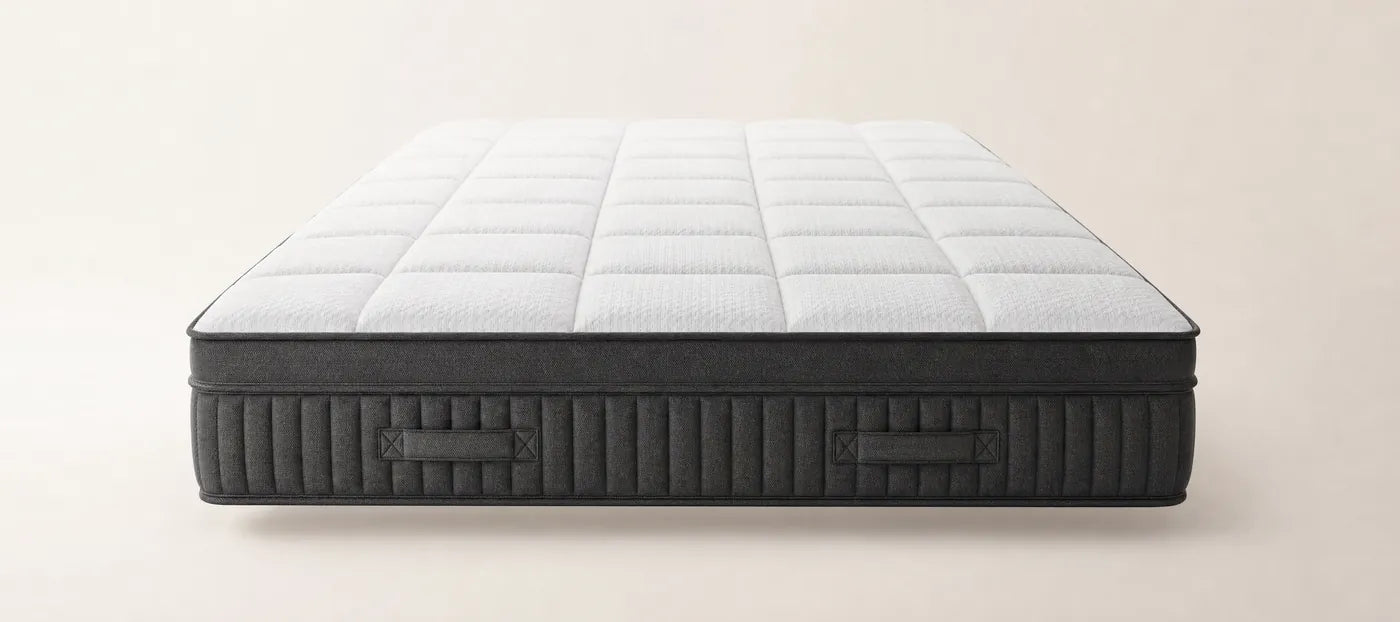
The Perennial is built so the comfort layer is a separate, removable part. The cover opens, the layer lifts out, a new one goes in, and the spring system that was never the problem stays where it is.
That is what the 25 year core guarantee covers: the part built to last, lasting. The part that softens renews.
The construction, layer by layer.