ONNI LONDON+ · Guides
Mattresses and back pain
Back pain has many causes and a mattress is only one of them. But there is a specific kind that a bed does create, and it has a recognisable pattern: you wake stiff, it eases within an hour of getting up, and it is better after a night somewhere else.
If that is not your pattern, the bed is probably not the cause and a doctor or physiotherapist is the better next step.
What the bed is actually doing
Standing up, your spine holds an S curve. The aim overnight is to keep it close to that shape. Muscles that hold a curve for seven hours are muscles that have been working all night, and they are stiff by morning.
Two ways a mattress breaks that line. Too little give and the widest parts of you, hips and shoulders, are held up while the narrow parts, waist and neck, are left unsupported in the gap. Too much give and the heaviest part, the pelvis, sinks below the rest and the lower back arches downwards.
Both produce morning stiffness. They are opposite problems, which is why the same advice cannot be right for everybody.
Position changes what you need
| Position | The problem to solve | What the surface must do |
|---|---|---|
| Side | Shoulder and hip are the widest points | Let them in far enough that the waist is still supported |
| Back | The lumbar curve leaves a gap | Fill the gap without pushing the hips upward |
| Front | The pelvis is the heaviest point | Stop the hips dropping below the ribcage |
Side sleepers get this wrong most often, because side sleeping needs the most give at the surface and the firmest advice is the most commonly given. If your shoulder aches in the morning, the surface is probably not letting it in.
Why zoning exists
A body is not evenly heavy. The pelvis carries most of the weight in a short span, the shoulders carry a lot across a wide one, and the waist and calves carry very little. A surface that responds identically everywhere will always be too firm somewhere and too soft somewhere else.
Zoning changes the spring response along the length of the bed, so the hips meet more resistance than the waist and the shoulders are allowed in further than the ribs. The spine stays closer to the line it holds standing.
Things that are not the mattress
- Your pillow. It sets the neck angle, and the wrong height undoes a correct mattress.
- The base. A worn or sagging base will pull a sound mattress out of shape.
- How long it has been. A comfort layer that has lost its rebound creates the exact dip that arches the lower back.
- A new mattress in its first fortnight. Changing what your body has adapted to is uncomfortable before it is better.
How the Perennial is built for it
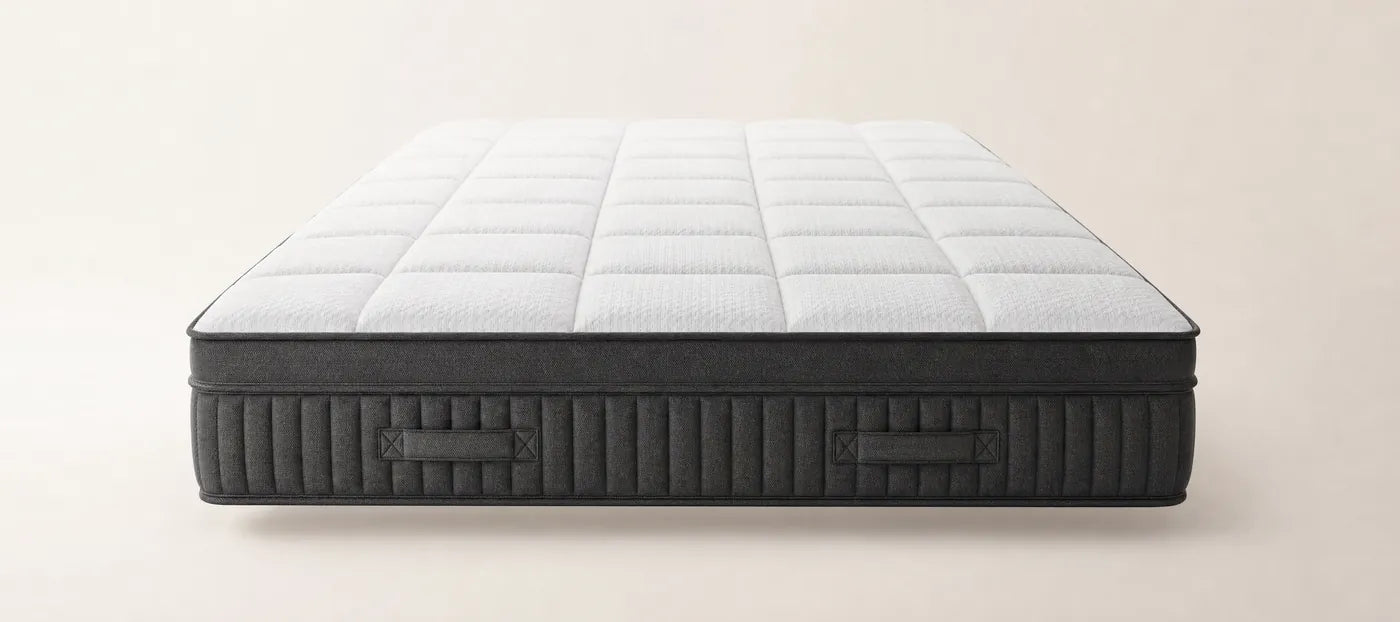
is twenty centimetres of individually pocketed springs in seven zones. Heavier two millimetre wire sits under the hips and shoulders, where the load concentrates. One point eight millimetre runs everywhere else.
And because position, weight and injury all change what you need, the comfort layer above it is a part that can be changed when what you need changes.
Where the support changes, and why.